


ℹ️) No chatbots were hurt during the making of this content.
The TL;DRs
The context:
This is an introduction to the ‘SEO Thinking’ paradigm.
'SEO Thinking' is my attempt to change how people think, talk, and understand SEO, and more specifically - the value of SEO.
I aim to develop 'SEO Thinking' as a paradigm, Explore SEO's unique nature as a problem-solving discipline, address current problems in and with SEO, communicate its value beyond generating search engine traffic, introduce frameworks to better comprehend and communicate SEO, and discuss SEO ethics.
The problems:
SEO is often viewed as a means to an end, which blinds the relevant stakeholders from the intrinsic values of the process. That may result in detrimental outcomes, the least severe of which is traffic.
SEO is no longer just about SEO. Therefore, it is time to go interdisciplinary. But for that to happen, the perception gap around what SEO means must change.
What to expect:
Expect more ‘How to think about SEO’ and less ‘How to do SEO’
I believe all SEO-involved personnel stand to benefit from reading this. Everyone who is working at, with, or around SEO in any capacity.
Thinking was here before me. I will share some respect to, and valuable resources from the works of others.
This is a work in progress, not a finalized product. There’s no consistent schedule as of now.
Before the beginning: What is my quest?
I always wanted to use the Monty Python ‘Bridge of Death’ as a framework to introduce myself, so I’ll go ahead and do just that.
My name is Shalom Zafrany.
My quest is to change the way people think, understand, and talk about SEO.
I Plan (with a capital ‘P’, yes) to achieve this by:
Further developing the idea of SEO Thinking as a paradigm
Exploring the unique nature of SEO as a problem-solving discipline
Talking about current problems with and in SEO
Communicating the value of SEO outside the realms of search engine traffic
Introduce a few frameworks that may help make sense of and communicate SEO
Discuss some SEO Ethics
And my favorite color is green. Or is it blue?
What are the core problems we’re dealing with?
Problem #1: Teleological SEO (or the ‘means to an end SEO’)
→ TL;DR: SEO is often viewed as a means to an end, which blinds the relevant stakeholders from the intrinsic values of the process. That may result in detrimental outcomes, the least severe of which is traffic.
Like all good things (said no one), let’s start with a Wikipedia quote.
Teleology or finality is a reason or an explanation for something which serves as a function of its end, its purpose, or its goal, as opposed to something which serves as a function of its cause…
…An intrinsic property is a property that a thing has of itself, including its context. An extrinsic (or relational) property is a property that depends on a thing's relationship with other things.
Put differently, teleological thinking means "start reasoning with the end in mind". It's not a bad thing by itself, and it can even prove helpful at times - especially if you are *trying to simplify a process*. The problem is that it may oversimplify complex problems and systems, lead to a poor understanding of a process, and blindside you from the intrinsic values of the actual process, which are often the very reason for the outcome to begin with.
For example, let us say, you desire to become famous. So you start with the goal in mind, saying - 'To become famous, I need to become viral or well-known by many'. One can become viral or well-known in many ways (and I'll let your imagination run course here.) Not all of them will make one popular, or respectable. In this case, failing to look at the process, makes one miss out on the intrinsic values of being famous to being with.
You may have achieved the result you wanted, but without the results’s value that made it attractive in the first place.
Here lies the first problem: The way most people think about or understand SEO is often teleological. This often leads to neglect of the process, misunderstanding, and misappreciation of the intrinsic properties of SEO, which are the main reasons for its extrinsic properties or outcomes in the first place.
I believe, that for a lot of people and organizations, SEO equates to SEO traffic. Many will only reduce SEO to its extrinsic value, which is the search engine traffic it generates. We’ll call this ‘Teleological SEO’ henceforth. By thinking of SEO with nothing but the end goal in mind, you may either be playing darts in the dark, inhibit learning, or worse - lose track of how it’s gained.
These are the key issues that arise from ‘Teleological SEO’:
Ethics & Integrity - by failing to consider the process, one may also overlook ethical considerations. This very type of thinking is what manifested 'black hat SEO' practices. For many, SEO traffic justified spam, deceit, and a great - and perhaps even unrivaled in a way - collection of offhanded tactics. Putting ethics aside, this also leads to a loss of integrity, respect, and reputation, not just for the SEO industry, but for the businesses practicing it, as well.
Unawareness & Aimless Execution - teleological SEO is bound by circular reasoning. It is doing without understanding, or having a clear idea ‘why’. Because you do SEO in order to gain SEO. And you gain SEO, by doing SEO. What SEO in actuality is, is beside the point for the sake of this achievement. You just don’t know. Or worse - you don’t care. You know that there are keywords involved. And some links. And sometimes, people will tell you to pay for those links. And you do it, because you want SEO traffic, so you do SEO.
Impediment to Learning & Growth - the teleological approach, with its focus on end goals rather than the process, also hinders the opportunity for learning and growth. This can be particularly detrimental in a field like SEO, which is constantly evolving. Ignorance of the actual process makes it difficult to stay updated with changes and to make new, more effective strategies based on past experiences. As a result, one may continue to make the same mistakes, wasting resources and opportunities. Is it working? Why? How can you tell? Will it work again? Are you learning anything? This is not limited to missing out on the opportunity of learning in SEO. You are also failing to learn about your market, your users, and your business. SEO is a pool of valuable knowledge and insights. You are overlooking its treasures.
Sustainability & Longevity - a teleological approach often leads to short-term tactics, which may lead to temporary boosts in traffic, but they are not sustainable in the long run. You lose sight of what matters in the quest for traffic and growth. You lose sight of your audience, what matters to them, and their expectations of you. You may have gained traffic, but that doesn’t mean you gained your audience’s attention or respect. So I ask again. Is it (really) working?

I believe one of the solutions to these problems and threats, is breaking the equation of SEO and traffic, by highlighting the intrinsic and valuable properties of the SEO problem-solving process.
'SEO Thinking' is my attempt to change how people think and talk about SEO, and more specifically - the value of SEO.
Problem #2: The meaning of SEO has changed. It isn’t its own thing anymore.
→ TL;DR: SEO is no longer just about SEO. Therefore, it is time to go interdisciplinary. But for that to happen, the perception gap must change.
ℹ️) Note: In this context, I use 'discipline' and 'industry' somewhat interchangeably. This is because the boundaries between the SEO industry (the economic sector producing SEO products or services) and the SEO discipline (the body of knowledge and expertise in SEO) are deeply intertwined. I think this is mainly due to it being a marketing-meets-technology (MarTech) industry, and a relatively new one, at that.
SEO, similar to most digital services, is unique (not special) in that its services and products emerged before any formal theory or philosophy. Solutions were developed in response to immediate market needs (or vacuum). Consequently, the discipline of SEO has evolved as a reflection of these commercial developments, representing a culmination of theories and knowledge that have been derived from the industry's practical experiences.
As a discipline, SEO has existed for probably nearly 25 years now. It gradually evolved and changed many times over, and while I believe that the foundations are mostly the same (get discovered → get evaluated → get indexed → get ranked → get engaged; repeat), it has changed. It became more complicated, nuanced, and more about everything that is not SEO. More specifically, it’s not that SEO is no longer about SEO, but rather that ‘SEO success’ (however you may define it), is no longer just about SEO practices.
These changes are the cause of a significant perception gap between SEOs and non-SEOs, and they resurface whenever SEO is brought up. It doesn’t matter who you talk to. It could be people in business leadership roles (“How much traffic can you get me?“), functional roles (“Can you tell me what keywords to put on the page so we can rank?“), colleagues (“Don’t do X because Google doesn’t like that“), or my mom (“Can you tell Google I can’t find the sofa Facebook showed me yesterday?“).
This perception gap essentially boils down to four key areas:
The expectations of SEO & SEOs (the expected results)
The definition of the SEO’s responsibilities (the scope of their work)
The SEO delivery (the practical implementation expected from SEO)
The SEO’s ability to fulfill these expectations and responsibilities and bridge the gap between them
The good news is, that in a way, this "evolution" is already happening (see some recognition of this sentiment in the next section). These changes were brought on as much by the growth and technical capabilities of the search engines and the internet at large, and by the growing demand (and by extension - the competition) for SEO, which forced it to grow as a role. But I believe we are currently at the best time to think about where SEO should be as a discipline.
I believe that the next evolution of SEO as a discipline is evolving from a multidisciplinary field to an interdisciplinary field.
→ Explore this idea further: If you wish to explore this idea, here's “A rather brief, irreverent, and probably historically inaccurate analysis on the evolution of SEO” piece that I wrote about these changes. But if you don't care to read through it, here's a summary of it:
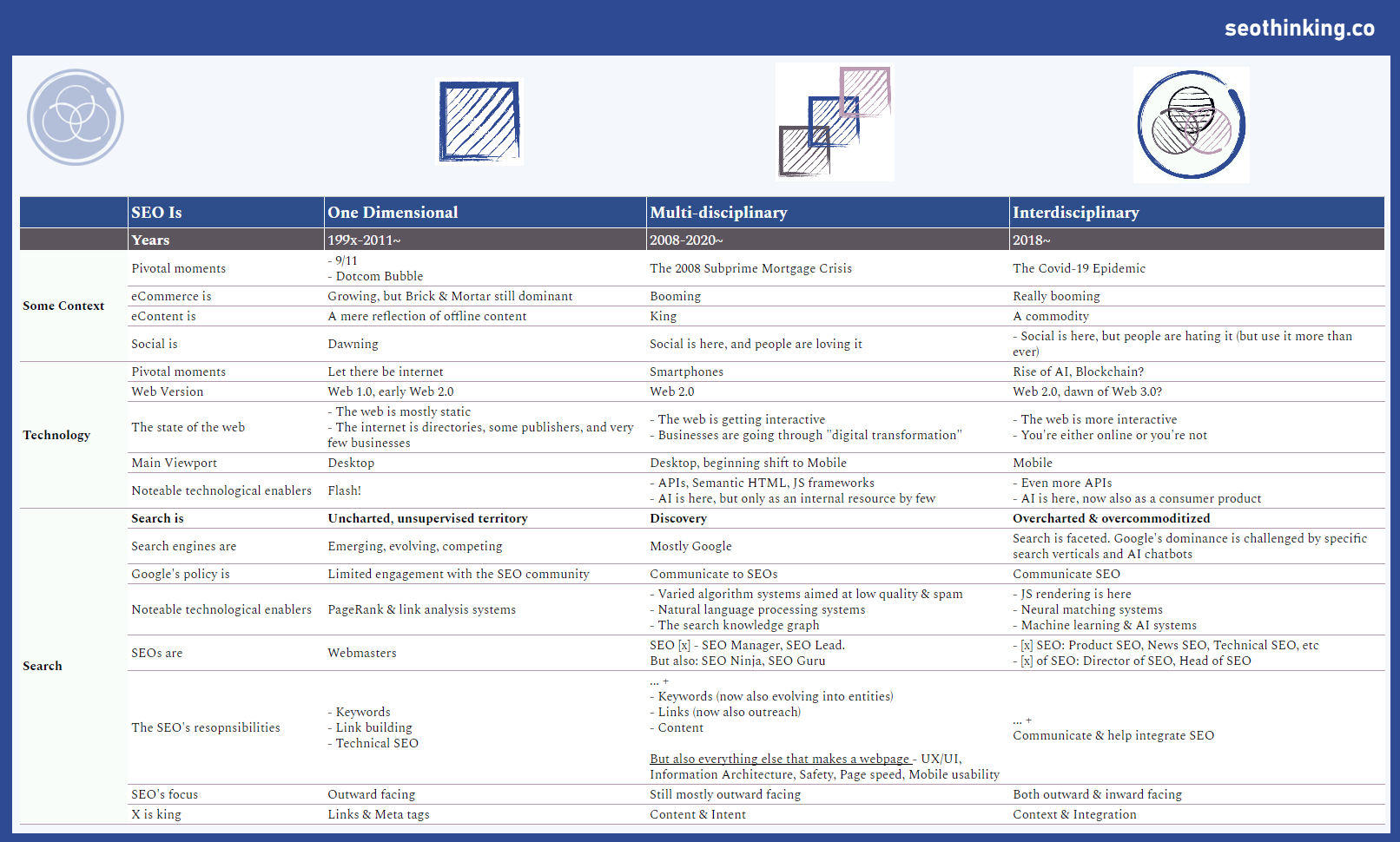
Setting expectations
→ TL;DR: Expect more ‘How to think about SEO’ and less ‘How to do SEO’
What I am offering:
Different ways to start thinking about SEO and its intrinsic values (i.e. not just traffic). Mainly as a problem-solving framework, and a way to benefit the web and its users.
A set of frameworks that will aid in creating a shared understanding of an often misunderstood discipline. Which I hope helps improve communication and set healthier expectations.
A discussion on the current problems with and in SEO.
Some ranting, probably.
High-quality top-tier memes.
What I am not offering:
It is not, by any means, a guide on 'how to do SEO', nor am I going to discuss best practices, specific strategies, tactics, checklists, and so on. So putting it bluntly, if you wish to learn 'how to do SEO' - this is not the place. I will try and guide your thinking, not your fingers. Which will then hopefully guide your fingers.
Why not?
I know it is not trendy in current professional spaces to 'not get down to business'. And I know there's a somewhat inflationary surge of 'framework' content sprawling around, that doesn't show you straight to the ropes.
Truth be told, many great resources already do a good enough job of teaching how to do SEO. So no need for more, I think. (I may or may not share some resources, but only if they help in advancing understanding. Time will tell.)
But more importantly, through both consulting and teaching SEO, I have come to a simple conclusion. SEO is (relatively) easy to do, not as easy to understand, and much harder to explain. And as time passes on, the explanation part bears more weight (more on that in a few paragraphs).
You can probably pick SEO up as a practice in a matter of weeks or months. Not all of it, granted, but enough to start 'doing' and call yourself a Guru/Ninja/[enter your preferred over-the-top cringe title]. And, you can do a lot of it without really understanding it, just from familiarizing yourself with a set of practices that may result in [enter your definition of search success]. I’ve seen it happen. Just follow the usual routine and process and hope for the best.
Explaining SEO on the other hand, requires not only a good understanding of SEO. It also requires a good understanding of how SEO interacts (and doesn't) with other efforts; it requires experience, that will shatter what you’ve previously learned, so you can separate truths from myths; and a decent set of soft skills. The latter I am ill-equipped to train on from the discomfort of my Ikea sofa.
And more than everything, I’d argue that explaining (communicating) SEO is as important today, as the doing part - if not more. There's a growing need for SEOs that can work within the thresholds and context of a given system - and not outside of it. And that is a good thing. But it comes with some serious challenges.
Who stands to benefit from reading this?
→ TL;DR: All SEO-involved personnel stand to benefit from reading. Everyone who is working at, with, or around SEO in any capacity.
This is for SEO-involved personnel. What does SEO-involved mean, you ask? Anyone whose day-to-day requires considering SEO requests and definitions. Do you do SEO, work with SEOs, or may have to consider SEO definitions in your work? Do SEOs come knocking at your door (be it a physical or a digital one) from time to time with questions or recommendations? Then congratulations, you are SEO-involved, and I believe you can benefit from continuing reading.
Yes, this should prove to be of some value for SEOs as well. SEOs often struggle to communicate their work and value. Even more so, they struggle to come to an agreement regarding their responsibilities and expectations.
So, I hope to make this interesting and valuable to all SEO-involved readers - be they SEO or not, by mainly exploring one key question: What problems can SEO solve (or create), how, and why should this matter to you?
So who’s it not for?
In general, that leaves non-SEO-involved personnel. People who don’t actually do or work with SEOs, and only have SEO as a traffic reporting channel in mind. Plainly speaking - those who only care about the results, and not so much about what goes into the process of earning it, are less likely to benefit from reading this.
Why?
One might argue that those are exactly the ones who stand to benefit most. Well, It’s just that I think that the real value of SEO is much clearer to see via the lens of your day-to-day responsibilities intersection. By witnessing its positive potential in your work and challenges. But I may be wrong.
Read on at your own peril.
A little respect (just a little bit)
→ TL;DR: Thinking was here before me. This is a standing section where I will share some respect to, and valuable resources from the works of others.
It’s important to clarify, that I am not inventing the wheel here. Yes, “Thinking” has been done before me. “SEO Thinking” as well. The notion of communicating SEO as an important aspect of doing SEO is not new. Something has to come from something. A lot of SEOs are thinking, practicing, contributing, and communicating healthy approaches to SEO, and have been for years. I have read, talked to, and encountered many. Which in turn, heavily influenced and helped shape my thinking.
In a sense, they paved the ground for what I wish to do here - advocate for healthier SEO thinking and mindset, and help it evolve further into a respectable interdisciplinary field.
In that spirit, throughout my posts, I’ll make a conscious effort to recommend resources that I believe provide the best ROA (*return-on-attention* - my personal and only KPI for good resources). From those individuals who focus on helping people understand SEO, and advocate (whether they mean to or not) for a healthier SEO mindset.
This will be a standing section in every future article, and I’ll try and keep the recommendations in the context of the piece you’ll be reading. *Substack readers: feel free to check my substack recommendations widget as well, under the same premise.
So here’s a little respect (just a little bit):
→ AJ Kohn's Blind Five Year Old - as far as I know, AJ doesn’t have a Substack, so I make it a point of sharing his entire blog. It is a general and invaluable source of inspiration to me, as an SEO professional. I dare say, that a lot of my professional leniences and beliefs stem from AJ's writings - and none of those failed me as of yet.
After the ending: A final introductory note
→ TL;DR: This is a work in progress, not a finalized product. There’s no consistent schedule as of now.
I have one last thing to share regarding this project.
It is a work in progress. This is a lab. You and me - we are all lab rats. I do not know where I am going with this yet. Yes, I do have some thoughts in mind, a long-thinking mileage on these subjects (which I preach on daily), a somewhat carefully laid structure, and tons of drafts. But it keeps changing, and just this introduction part took me several months to get out. I rewrote it at least 10 times, and I‘m still not that happy about it. Thinking is hard. Writing is harder. Finding time to write is hard. Writing as a form of thinking can be both complimentary and detrimental to the process. You are naked before the page, yourself, the world, and your god(s).
But waiting should be easy cause I’ve yet to prove anything to you.
Anyway, just thought I’d let you know.