


The SEO prefix puzzle
Reframes, people. Reframes.
SEO often comes prefixed with various terms—Technical, Brand, YouTube, Black Hat/White Hat, Teleological-SEO, Python-SEO (🤷♂️); And the list goes on. Being a patternaholic (not a word, don’t care), I wanted to break down the types I’m familiar with into distinctive context groups to unlock how SEO is communicated. So I started by segmenting the types of SEO into sub-types like Platform-SEO, Effort-SEO, and so on.
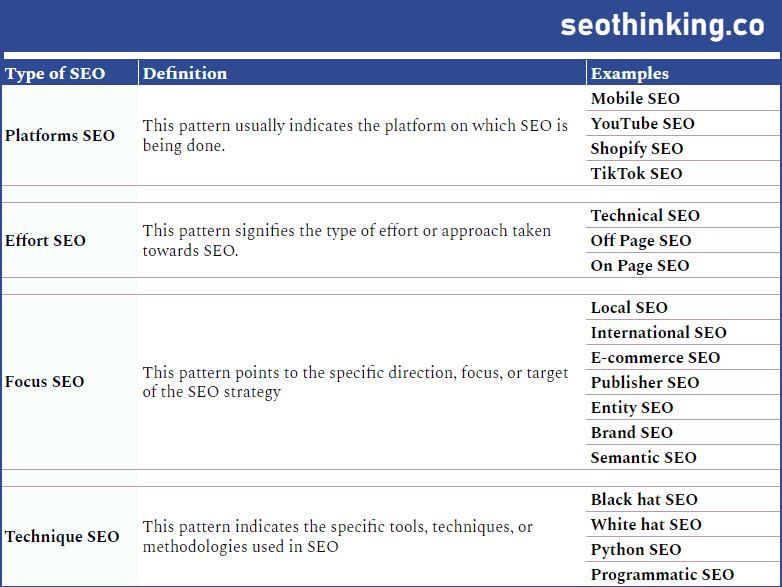
It makes sense and all, but it didn’t seem very helpful for me to draw constructive conclusions. So I asked myself - Am I actually helping someone with this? And so I decided to rethink the problem. And I quickly came to a simple conclusion: they can all be further distilled into two simpler and more fundamental ‘types’ that more easily communicate the promise of SEO - helpful, and not helpful.
It’s not that there’s no value in such labels. They are great for targeting, and useful for the sake of distinction, highlighting differences in expertise, focus, and priorities. (and more on that later.) But for me, these are redundant if we wish to understand the core value of SEO.
The role of SEO is to drive business outcomes, by helping businesses deliver solutions that will satisfy user needs and expectations in search, whilst overcoming search engine challenges. It requires an understanding of the problems and challenges each of these beneficiaries faces and striving to help them overcome their problems.
For SEO to achieve its role, it must be helpful.

And without further ado, the two types of —acting…?
Action!
Let’s begin with a convincing analogy. To drive the entire argument forward, I'd like you to watch this short excerpt from an interview with Tom Hardy that resonated with me I resonated with. (See if you can see what I did there).
In short—if you cannot spare the 40 seconds of a YouTube Short—Tom gets a bit defensive corrective philosophical when being called a 'method actor'. Here are some of the relevant points:
I'm not (a method actor...)
Fundamentally... there are two kinds of acting: Convincing, and not convincing, and then moved away between the two is any method necessary...
—Tom Hardy
He simplifies the definition of what he does into a single, easily communicable, and pragmatic approach. Yes, the more specific goal could be to have you entertained. Or to make you think. Or laugh. Or cry. Or get anxious. But for all of these to happen, the audience must first be convinced of the authenticity and the delivery of the acting. That is the primal and primary role of the actor.
And just like in SEO, there are many "types" of acting that are commonly referred to:
There are different disciplines of acting, like 'Method acting', 'Classical acting', 'Modern acting', etc.
There are different platforms, like Theater, Television, or the Silver Screen that may require a nuanced approach fit for the platform.
There are also external areas where acting happens in or is required, beyond the realms of culture, like politics, relationships, negotiations, and most social interactions, really. We just rarely think about those as acting.
But they aren't so much ‘types’ rather than ways and methods the actors choose to pursue to fulfill their role, or contexts wherein delivery of the act happens. That is the essence of it. The why. The predominant rule of success. The ‘win criteria’, if you (I?) must use the word 'win'.
Finding your core, remembering your why’s
Simple truths, obscured by segmentations
This happens in every field. Take marketing, for instance, with its myriad of sub-types and prefixes like Digital, Brand, Content, Email, Affiliate, Social Media, Guerilla, etc. These subdivisions have value, but if you're anything like me, sometimes you hear people describe "Growth Marketing" and think, "I hear you, but aren't you just describing marketing with extra steps?”
Truthfully, the segmentation of a field by various aspects does hold some value. It provides context, helps us make important distinctions, and sets expectations—whether functional or as a part of identity building. It reflects how fields grow and adapt to changes and challenges.
What’s important is, however, that regardless of how complex and specialized things become—and with them our growing need to find new ways to communicate them—we remind ourselves that the key to success still lies in understanding and fulfilling the core purpose of that field.
Additional examples:
Success in acting isn't just about making someone laugh or cry, nor is it about the dedication to a challenging or rigorous path. It's about convincing.
Success in SEO is not about posting n words/articles, or “building” 100 links—it is about driving search satisfaction through helpfulness.
Success in marketing isn't about 'growth hacking' or crafting catchy slogans. It's about connecting with your audience.
Success in investing isn't about accumulating assets or mastering financial instruments. It's about wise allocation of resources that generates sustainable growth.
UX research/design isn't about knowledge accumulation or designing beautiful interfaces. It's about guiding actions by solving real problems. (see reading recommendation at bottom of the article.)
(Stereo)types? Simplify reality and make faster decisions.
I’m like my mother, I stereotype. It’s faster.
—Ryan Bingham (by George Clooney, ‘Up in the Air’).
Back to being helpful
What’s the purpose?
Just as acting must be convincing to fulfill its purpose (=achieve its outcomes), SEO must be helpful. But why is ‘helpfulness’ of all things the core promise of SEO? Let’s go back to the first principles of searching.
Searching is fundamentally about problem-solving, and help is at the core of this process. The ultimate goal of a searcher is to find a solution to their specific problem, and search engines are designed to provide that help. They do that by connecting searchers with businesses and individuals who can offer good solutions.
But this isn’t as streamlined as it sounds.
How can audiences effectively (re)search their problem? How can they easily find what they are looking for? How can they tell what is a good/best solution?
How can businesses know what to offer to individuals? What problems are worth solving that are solvable by the business? What problems are businesses causing themselves to their audience, that they are not familiar with?
How can search engines accomplish that gargantuan task of matching every need with the most satisfying available solution to every potential query?
This is where the purpose of SEO begins. To help these actors overcome their challenges. SEO is about doing the things that help all the actors in this equation overcome their challenges in a way that mutually benefits everyone.
One common way to classify business outcomes online is conversions (goals met, e.g. purchases, sign-ups, read-throughs, etc.). Let’s consider that outcome as our starting point to analyze SEO’s purpose.
User conversions are a result of users' expectations meeting relevant business offerings at the appropriate phase of the funnel.
Before conversion can happen, you must first draw the relevant audiences in (traffic).
To get traffic, you must first gain visibility for relevant problems (=queries). To gain (and keep!) search visibility (i.e. ranking), you need to help solve audience problems and meet their expectations, by:
Creating, offering, and communicating business solutions and collaterals that aim to provide a helpful and satisfying outcome for audiences. For example, SEO may help businesses ideate which collaterals are worth creating and communicating, in ways that would meet the searcher's intent and satisfy their expectations.
Overcoming search engine challenges (get discovered, crawled, understood, indexed, ranked, and served). For example, SEO is about ensuring there are sufficient ways to discover and index the content, like using links and creating sitemaps.
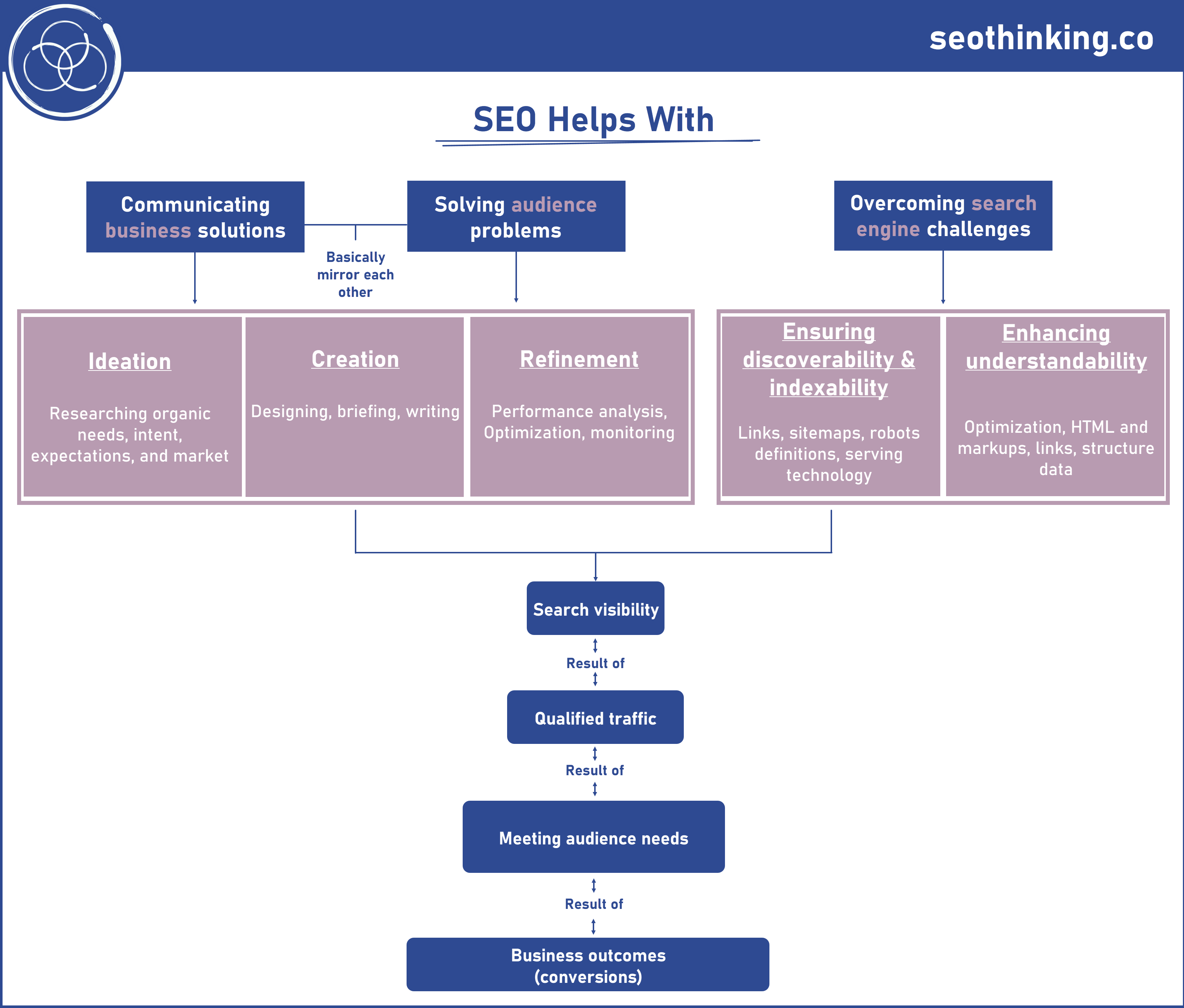
This definitely isn't all there is to it, and it isn’t as linear as that, as there are cross-dependencies at every step of the way due to the cyclical nature of search engine ranking. But at the end of the day, your focus as an SEO is to find ways to provide helpful solutions to search-related problems, aligning the needs and expectations of all three SEO beneficiaries (business, audience, search engine).
Helpfulness is a warm gun
It works… until it doesn't.
You may still wish to argue that helpfulness is still too vague. That purpose alone is disconnected from reality. You may have heard or even had experience with hacks, tricks, and shticks that weren’t “helpful” but drove search success (probably traffic). That there are other ways, not necessarily manipulative, that can more easily drive outcomes. “The secrets of the trade”. Hell, SEO has a notorious reputation for a reason. (Disclaimer: I find this article almost criminally one-sided, but also feel a lot of the criticism is valid and long overdue.)
You may have even noticed a certain part in the quote presented at the beginning by Tom Hardy:
Then moved away between the two is any method necessary, including fake it to make it...
—Tom Hardy
So I feel like this specific argument deserves to be broken down, for those of you who may still feel like SEO is about hacking that Google black box, that the game is rigged, and you should do whatever it takes to win (enter Black Hat SEO). I'm here to argue that any method necessary should mean any method that achieves helpfulness. Just like the acting example should mean “any method necessary” to deliver a convincing performance.
Putting purpose aside for now, I’ll break it down into two points - ethics, and merit.
Ethics - I'm not just blindly reiterating Google's principles here. I believe integrity is important, and must be considered in all types of service and communication. Ethical behavior fosters trust and builds a positive reputation, leading to increased audience engagement and satisfaction. So speaking for myself at least, anything that goes against it, is a no-go on a strict ethical standpoint.
Merit - But is not just a question of ethics, but of merit. Ethical concerns aside, there's also the question of achieving your desirable outcomes. To put it bluntly, unhelpful solutions, won't work in the long run, and they put you at a risk of achieving the opposite. Even if you managed to "push one through" the search engine algorithm, it is mostly, probably, just a matter of time until audiences react against it, and/or search engines refine their algorithms. Consider the following:
You managed to rank #1 on Google for a query by hiding keywords/stuffing all the keywords into the page/buying fake links. You drove significant traffic for a while - your ‘any method necessary’ brute force approach worked. That traffic was useless for audiences, as they landed on the page and found there was no solution available for them. Google learned from their feedback that your page doesn’t provide a good solution for these queries and down-ranked your page.
Under the same scenario, Googlers also picked up on these practices and realized their manipulative nature. It is now a policy violation and is considered spam. Their algorithms can now identify such behavior automatically. Your entire website may be flagged for de-ranking, even de-indexing.
This also helps to explain why doing things that are good for search engines—not just manipulative—doesn’t always/immediately/necessarily help. Improving the efficiency of discoverability and indexing doesn’t provide you with immediate outcomes when the actual solutions aren’t that great. It isn’t just about helping the search engines do their job. You must address and help solve real problems.
Audiences are looking for solutions to their problems. They vote with their mouses, keyboards, and fingertips. Their engagement provides the feedback required to signal satisfaction. And it is just a matter of time until the helpfulness of a result is determined. (It works until it doesn’t.)
Reflection: Help yourself help others
How to begin assessing helpfulness
In summary, I encourage you to reflect on your SEO practices in terms of helpfulness. Especially in volatile and speculative fields like SEO, some actions—not necessarily manipulative ones—may seem like a good idea, or could even seem to have achieved the desired outcome. But if you look through the horizon of short-term gains, do they really? How can you tell? Did they help anyone overcome a challenge? Are they sustainably helpful?
This question should be top of mind whenever you're at a fork in the road: Am I actually helping someone?

The real question is not whether SEO is or is not about helpfulness. The real question is: how do you determine helpfulness to begin with?
I believe you can start with my threefold framework: ethics, purpose, and merit.
Ethics. Ethics is subjective. There are some more universal aspects to it that I believe most are on board with. If you lack a moral compass, or if you do have morals but don’t find it actionable you can always look up search engines’ search policies as a starting point. But still - you do you and have the outcomes you deserve.
Purpose. Align yourself with the purpose of Search.
Align yourself with the goals of the business. Help businesses solve problems that are worth solving for them. That make an impact. That makes sense. That not only drives audiences in but also tells a story about how that business respects and helps the audience.
Align yourself with the needs of the searchers. Research their problems, but also try and feel their problems. Practice empathy. A good place to start is the concept of ‘Design Thinking’. Observe and engage before you design solutions. Do your research, but then reflect upon it to ensure the real issues are being addressed.
Align yourself with the problems of search engines. Search engines strive for efficiency and audience satisfaction. Understand their algorithms, but more importantly, understand their core goal: to help users find the most satisfying result. Optimize not just for ranking, but for real user satisfaction, which search engines aim to measure.
Merit. Merit is determined by the outcomes of what you do.
You can (and should) try to theorize and speculate regarding the potential outcomes by doing research, testing, etc. But at the end of the day, reality will determine helpfulness. Analyze what worked, and why, and verify its sustainability. Measure results, iterate, and improve.
It's important to track outcomes through data, but also through qualitative feedback that indicates long-term success. Is your content continuously helpful? Does it still serve its audience months or even years down the road? Helpfulness is a moving target, and ongoing evaluation is key to maintaining relevance and value.
May you be forever helpful in your efforts.
A little respect before we go
One way to achieve clarity regarding your work's purpose is honest reflection on its impact. A while back I read this article by Ki Aguero. In it, she reflects upon the impact and role of UX research, and how it should lead to actionable insights rather than be done for box-ticking or professional vanity.
To me, this highlights the importance of understanding a field's core promise to ensure efforts are impactful by being aligned with its core values. It is all about understanding your ‘Whys’, and asking yourself how you contribute, and what problems you help solve.
The point of UX research is action, not answers | Ki Aguero