


ℹ️) Some chatbots were mildly brought to exhaustion during the making of this content.
ℹ️ℹ️) Also, this is kind of long, I recommend that you open the article to read outside the limiting constraints of your inbox. Freedom over form!
The TL;DRs:
The context:
Google is being sued.
A former Googler's testimony reveals the use of clicks in rankings.
SEOs rejoice.
An allegory is born.
The allegory:
We always kind of knew Google uses user interaction in search. The real question is: why is this being celebrated as a revelation? In short: because Google and SEOs don't trust each other. In not so short? Just go and read the thing.
The main points & what’s offered:
Google's cautious communication is driven by fears of spam, competition, low-quality content, and fear of misinterpretation & scrutiny, which causes it to inherently treat SEOs (and not just SEOs) with a guarded stance.
SEOs carry a sense of entitlement due to their role in optimizing the web, leading to frustration over Google's vague guidance and lack of acknowledgment thereof.
Google faces a communication dilemma, in which it expects to benefit from the guidance it provides, without causing manipulation or scrutiny. At the same time, these efforts frequently lead to misinterpretation and trust issues, presenting a complex challenge with no clear solution.
Thoughts on the future of the Google-SEO relationship and trust, with the rise of AI plain view.
A short screenplay
The Google antitrust
This article isn't about the trial, but just for the sake of context:
Google is on trial, filed by the US Justice Department.
The main argument is that Google broke antitrust laws, and illegally abused its power to preserve its monopoly.
Eric Lehman, a former software engineer at Google who worked on search quality and ranking, said the following:
Pretty much everyone knows we’re using clicks in rankings. That’s the debate: ‘Why are you trying to obscure this issue if everyone knows?'
—Eric Lehman, former engineer @ Google, in US VS Google antitrust trial
…And there was much rejoicing.
The big reveal
A lot of the conversation looks at this reveal as if Google were caught with its pants down. The lie has been brought to light, and now SEOs can rejoice for knowing all along.

It appears that most care about this new revelation because it gives them one (or two) of two things:
Vindication - This revelation confirms long-held suspicions, providing a sense of ownership over the truth they felt was missing. In their eyes, this is - no less - a moment of reckoning for Google's lack of transparency.
Ideas - “novel” ideas on how to rank. (Sigh.)
But for me, this story (and mainly the feedback to it) isn't about clicks, ranking, or Google's algorithms. It is an allegory. One that highlights the relationship of mistrust between Google and the SEO community.
To put it bluntly, Google and SEOs don't trust each other. On one hand, SEOs don't trust Google to provide them with the whole truth, which leads to frustration on behalf of SEOs. On the other hand, Google doesn't trust all SEOs to be able to handle it responsibly. From the POV of Google - putting aside legal and competition-related reasons, if SEOs do get the truth, the whole truth, and nothing but the truth, it will lead to SEO manipulation and more spam.
—> (A "You can't handle the truth!" meme is extremely befitting here, but it is way too easy, and so I must practice restraint.)
It is worth clarifying that this relationship has seen a tremendous improvement in recent years. The Google documentation about SEO has never been better and clearer (I'd even argue that it competes *with* SEOs on SEO-related topics). Google's Search Relations Team does a tremendous job both proactively explaining concepts and tackling community questions, some of which are sometimes borderline offensive and cringe-worthy. Hell, John Mueller even won an award for 'Global Search Personality of the Year'. What better way to nurture a relationship than shower praises? Even on the SEO community side, more SEOs than ever communicate Google's ideas, and use Googlespeak when explaining why to do SEO-related things. Hell, I’m no different.
And yet, the seed of mistrust is still evidently here. Google is aware of the dangers of just letting SEOs do what they do without proper supervision, and SEOs are still trying to pick the machine apart and understand how it works so they can succeed in search results, despite any guidance Google may or may not give them.

So who's at fault here? Why is the relationship so wrought with mistrust? Should Google talk to SEOs, or not? Who exactly are these SEOs, and who represents them? Are they a cohesive bunch? Do they all eat spam for breakfast? Are all degrees of spam equal, or is some spam equal more than others? Does more communication lead to a healthier search with less spam, or does it just widen the appetite of spammers? All of these questions, and more - may not be answered here. But some will.
We’ll need to consider both points of view in hopes of a revelation. Let’s start by putting both parties on the stand and listen to their opening statements.
The Google perspective: Let’s hedge things out.
I think it is safe to say, that Google's perspective is simply one of a guarded stance. At the heart of Google's behaviors, lies the need to defend itself against five things (there may be more, but I like five).
#1. Competition
Competition is pretty straightforward so I’ll spare you the reading time.
#2. Spam
Spam should also feel pretty obvious by now. I'm talking good old-fashioned old-school spam. Keyword stuffing. Cloaking. Hidden things behind not-so-hidden things. General manipulative efforts. And being honest, I don't think that SEOs can be attributed to all of the spam. There are plenty of bad actors out there who don't carry the SEO acronym on their chests. But some do, sure.
#3. Low-Quality waste
Low-quality waste should probably be expanded upon. But, because I have so much to say about it, I'll do it some other time, once I figure out what it is I have to say. In its entirety I mean. But in essence, the main issue with most content is that it can be very mediocre, to the point of it being a wasteful effort on Google's behalf to spend precious resources on it and to risk chipping away at the trust of their users.
#4. Misinterpretation
Oh lord, please don’t let me be misinterpreted
Over the years, Google has become more proactive regarding communicating SEO to SEOs. As a result of the increase in communication, there is fear of misinterpretation (I'm doing great, aren't I?).
The fear of misinterpretation has to do mainly with Google’s fear of saying one thing, and SEOs (and other avid listeners) interpreting another. This is arguably the most significant risk Google faces when discussing its services, practices, and policies. When you're this big, every slip-up matters. It can lead to outcomes that are either beneficial or detrimental. The web can improve, or it can suffer.
We can break down the fear of misinterpretation into three categories, in ascending order of importance:
Misinterpretation of definitions - not correctly separating between theories and facts, and mixing between realities. This can lead to wasted efforts and misinformation.
Misinterpretation of outcomes - misinterpretation of the expected outcomes or results. Or as far as SEOs are concerned - the expected rewards for their efforts. This can lead to angry creators and businesses, and eroding trust.
Misinterpretation of intentions - this leads us straight to the next, and final point.
#5 Scrutiny
Google fears being scrutinized. Google being misinterpreted can bring forth unwarranted outcomes for the web (more on that later). But perhaps even worse for Google, these slip-ups can and probably will be weaponized against them. The controversy around "Google using clicks" serves as a prime example.
And with great power, comes great
responsibilityscrutiny.
The SEO perspective: I think I'm entitled to--
Don't go around saying the world owes you a living. The world owes you nothing. It was here first.
—Mark Twain, A Tramp Abroad
I believe the mistrust and frustration SEOs feel towards Google can largely be attributed to a single factor: they feel entitled. SEOs feel entitled to certain privileges & guidance that Google does not fully acknowledge. This begs the question: where does this sense of entitlement come from, and why do SEOs believe Google has to give them anything in the first place?
In short, I believe it stems from the crucial role they play in the digital ecosystem. Whether this belief is justified is subject to debate (and there are many differentiated opinions on the matter, to say the least). But that sense of entitlement does exist - regardless of its validity, or whether SEOs are consciously aware of it.
Let's briefly unpack:
#1. Google is the gateway(s) of the internet.
Yes, its dominance is continuously challenged, but it is the #1 touchpoint for most digital experiences. If you consider not just Google search, but YouTube (the second largest website in terms of visitors), Google Workspace, the Android OS + Appstore, Google Chrome, etc. It is not only the #1 website in terms of visitors, it is the gateway for most digital experiences and information gain. Even the next largest gateways get staggering amounts of their visitors from searches.
→ Datapoint1
As of January 2024, Wikipedia gets 83% of its visitors from organic search; Reddit gets 60%; Amazon - 20% (+ 5% paid search); X/Twitter - 13%; Instagram - 18%; Facebook - 12%; TikTok - 28%. For TikTok, that means 644M monthly visitors from Google Search alone).
#2. This gateway needs help to grow and maintain itself.
Like all user-generated content platforms, Google is only as good as the content created by its users. I’ll argue that the success of UGC platforms hinges on two pivotal axioms (there may be more, but I like two) -
The demand and expectation for high-quality and relevant
contentinformationanswerseverything is always on the rise.As it grows, there comes a certain point where all platforms need to start policing their users' content (or face criticism and scrutiny).
Google must ensure that the indexable internet is not only continuously expanding and improving, offering greater and better content as time moves on, but also becoming more sustainable and manageable. And by that, I mean proactively making sure it is easier to discover, crawl, index, understand, and moderate.
#3. The User-agents of order and chaos.
(See what I did there? I’ll one day rid myself of the need to belabor jokes, but today is not that day.)
And so, enter the SEO industry. SEO is not just a way to get businesses some traffic, but an important agent of change for search and search engines. Meaning, that it is not just a way to optimize websites for search engines, it is a way to optimize the web for search engines. They help optimize websites, making them easier to discover, crawl, index, render, and understand, not just for the sake of websites but also for the benefit of the search engines themselves. These things not only make the search engines’ job easier, but they are also a tremendous contributor to cutting costs.
Their role is pivotal in not just cutting costs and enabling technology, but also in steering the digital ecosystem towards Google's vision. SEOs not only optimize, but they serve as actual messengers for Google's evolving needs—whether it's the shift to mobile-first, enhancing security, improving page experiences, eliminating interstitial ads for Google users, or enabling advanced rendering schemes and schema implementations for a deeper understanding of web pages. Whether they like it or not, SEOs advocate for Google’s priorities. It is one of the tools at Google’s disposal to steer the titanic ship (not to be confused with the ship Titanic) that is the World Wide Web. (‘The Webship’?)
And so, SEOs are a necessary catalyst for change. Google needs SEOs to achieve its mission(s) and remain the most relevant digital gateway. They are crucial for communicating necessary changes and championing maintenance, change, and moderation (even if more often than not, SEOs are the ones who require moderation). They help Google steer The Webship* for the benefit of both Google, users, and businesses.
*Grammarly is really angry with me on this one.
And SEOs - they know this, even if they do not explicitly think it. It is internalized. And from this understanding, comes a growing dissatisfaction with Google for not fully paying their dues. So they feel entitled. Should they not?
Entitled to what, exactly?
SEOs feel entitled for two things (there may be more, but I like two):
Respect - in the form of cooperation, transparency, and actionable guidance.
Rewards/compensation - in the form of search success.
Let’s consider how Google accommodates these expectations by moving the exhibits phase.
Exhibits
Mistrust Exhibit A: Googlespeak and you shall be misheard
Let’s consider the EEAT concept, and how many SEOs get it wrong, thus offering a glimpse into the communication challenge between Google and SEOs. Here’s a short explainer on EEAT and the Google Quality Raters Guidelines, but you can skip it if you already know about it.
—> Explainer on EEAT and the Google Quality Raters Guidelines
The Google Quality Raters Guidelines (henceforth QRG) is a document published by Google aimed to help human raters judge the quality of web pages and the search results leading to them. The document touches on topics like page purpose, page content categorization, content authorship, page quality, mobile friendliness, and more.
Among these concepts, is the concept of EEAT (Experience, Expertise, Authoritativeness, and Trustworthiness), which is a prominent framework offered by Google to its human Quality Raters.
Though the document doesn’t discuss ranking signals directly, it is widely viewed by the SEO community as a mirror of Google’s thinking and can be used to understand Google’s point of view regarding the quality of the results they wish to surface.
It is also important to understand that the quality raters themselves don't impact rankings directly, as they are not evaluating the websites but the algorithms' success in surfacing the highest quality results. In that sense, they do not affect an individual website’s ranking, but rather the entirety of the indexed web’s ranking, as they provide benchmarks to Google’s algorithms and help train its machine learning systems.
In an interview with CNBC, VP of Search Engineering at Google, Ben Gomes, said:
“You can view the rater guidelines as where we want the search algorithm to go,” Ben Gomes, Google’s vice president of search, assistant, and news, told CNBC. “They don’t tell you how the algorithm is ranking results, but they fundamentally show what the algorithm should do.”.
So what’s the problem with the EEAT concept? SEOs misinterpreted it.
I like the following quote from Lily Ray »
As is often the case with the exchange of ideas within the SEO community, the discussion around E-A-T quickly led to confusion, misunderstanding, and misconstruing of facts.
Many of these misconceptions stem from a disconnect between what is theory and what is currently live in Google’s algorithm.
—Lily Ray | Google’s E-A-T: Busting 10 of the Biggest Misconceptions
In short, Google offered a general framework to their quality raters, which SEOs picked up on. Being the ever-diligent-opportunity-seizers that they are (not judgemental), they brought it back home with them and kept showing it to people.
The results? For all intents and purposes, EEAT is a ranking signal and must be communicated as such to our stakeholders. What in actuality EEAT is? We'll figure it out and make sure the entire internet has it.
While the "failing to understand the difference between theory vs what is real" disconnect Lily Ray offers is an extremely attractive path to conclude this entire section with, let’s try and take a look at the source of the disconnect.
In an official but non-policy document, Google offered a general framework for their quality raters - not SEOs, to use (but then Google kinda kept telling them about it).
While reiterating over and over - this is not the way our algorithms are designed to rank content (but it is how they would if they did).
Also, it doesn’t affect ranking (but it does help train and feedback on the ranking systems).
Okay, there’s some evident mixed signals there. But mixed signals aside, I think it is also worth talking about an inherent issue causing this confusion: deeply rooted differences in priorities and vision.
Google's priorities and vision focus on steering the web in a direction that benefits both them and their users while dodging the bullets of scrutiny. In contrast, most SEOs’ priorities are a bit more humble: ensuring their websites and the businesses they represent thrive in search rankings. They are less concerned with the broader trajectory of The Webship, focusing instead on what directly affects rankings in the short term, often summarized by their interest in whether "X is/is not a ranking signal." (See also #Teleological SEO).
The problem? Google isn't playing along. Statements like "focus on content", or write "people-first content" do not align with the direct, actionable insights SEOs seek to improve rankings. That is because Google's statements aren't meant to help SEOs rank their websites. They are meant to make sure Google's priorities are met, often even beyond the concept of ranking. And for some reason, SEOs keep forgetting that.
For example, making sure your content demonstrates EEAT isn't explicit enough. “Include author bylines”, however? Actionable. [✅Added to task list.] Now, do author bylines make sense? Very much so. But can Google come out and say "This is a direct ranking factor"? Nah-huh. Moreover, it probably isn’t, as it just doesn’t make sense to rank the entire thing just by the mere inclusion of a byline. Especially, if it can be faked.
At the end of the day - SEOs misinterpreting EEAT probably had more favorable consequences than negative ones. But this inexplicit hedged Googlespeak, which isn't providing SEOs with the direct actionable guidance they feel entitled to, directly contributes to a sense of mistrust in upcoming Google advice, and Google’s ability and intentions to guide them.
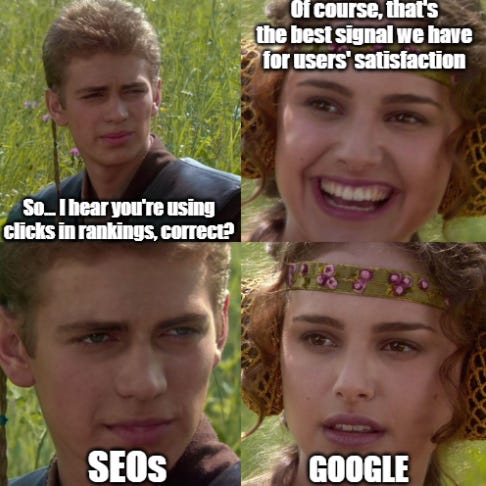
On the other end, consider just how negative the consequences could be, if instead of stating ‘Users are important, so you should focus on creating people-first content’ Google was to explicitly say, 'We directly use user interaction in rankings'.
“Directly use in rankings” is the holy grail for SEOs, as far as Google statements go. But even those could be misinterpreted and lead to detrimental outcomes. User interaction as a ranking signal? That's still too vague to act upon.
User clicks, however?
…That can be arranged.
Mistrust Exhibit B: Whose success is it, anyway?
I mentioned that SEOs’ expect two things - respect, in the form of clear and actionable guidance, and rewards, in the form of search success. We mainly talked about the former. Let’s talk about the latter.
There’s this other thing eroding the trust between SEOs and creators, and Google: the appropriation of creators' content by Google. Over time, Google has evolved its SERPs to not only answer users' queries more directly but also to keep users within its ecosystem for as long as possible. This evolution has given rise to features like featured snippets, knowledge panels, and other SERP elements that use creators' content to provide quick answers, often without requiring a click-through to the source website. What is commonly called, ‘Zero Clicks SERPs’.
This practice raises significant questions about the value exchange between Google and content creators, which has been debated for quite a while. For SEOs and creators, the effort to rank in Google's SERPs is not just about visibility but also about driving traffic to their sites. When Google uses its content to answer queries directly in the SERPs, the potential for traffic—and by extension, revenue—is diminished. This not only impacts the immediate return on investment for content creation but also raises broader questions about the ownership and value of content on the web.
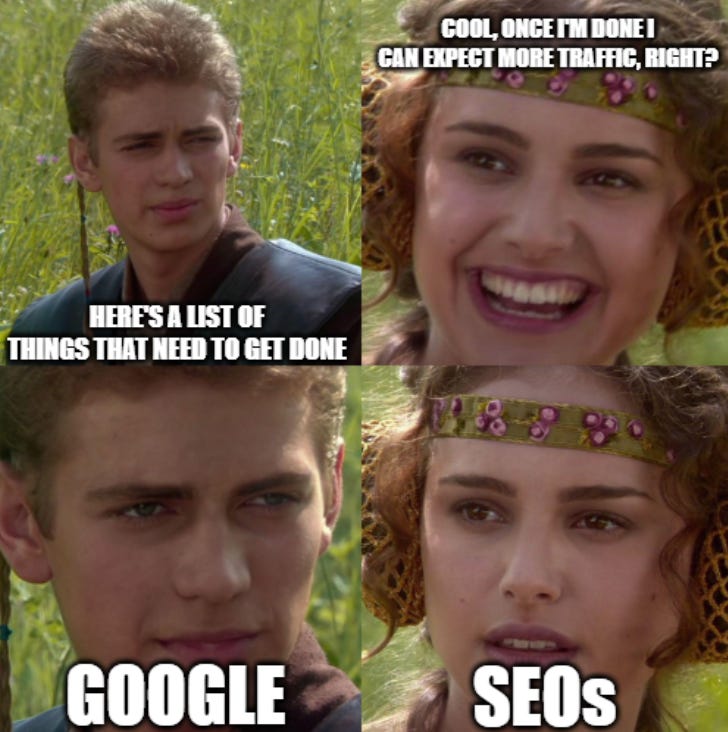
But this phenomenon isn’t exclusive to content creation. It meets search engine optimization at large. When Google presents creators with unique ‘Structured Data’ solutions to make their content more easily understood by Google and ties it with certain visibility rewards, it essentially creates an equation: do this, and you shall be rewarded. And, this is exactly, what the SEO entitlement is all about. Clear, actionable guidance that leads to rewards.
The problem? It doesn’t necessarily do. It may not work; It may work but then get deprecated shortly thereafter (shoutout to FAQs); It may work, but used by Google for training their algorithms and later for their own search visibility.
Closing arguments and the communication dilemma
After reviewing both perspectives and going over some exhibits, let’s combine them to provide an overview of the two entities’ stances.
SEOs are/feel they are working for the benefit of Google, so they feel entitled to two things:
Actionable guidance from Google.
Search success for following suit.
More than ever, Google does deliver on that guidance, but it uses hedging practices. They often use ambiguous language and provide somewhat unactionable guidance and transparency, since too direct of guidance can lead to competition picking up, manipulation, and/or scrutiny.
But, at the same time, Google fears being misinterpreted, as misinterpretation may lead to detrimental results - both on the web level and Google’s business level. So they must make sure they’re as clear as possible, without inadvertently overpromising on the potential outcomes of following its guidance.
Since the guidance is often ambiguous, it ends up being misinterpreted anyway, by SEOs and creators who are starving for guidance that will help further their careers and businesses.
That misinterpretation leads to various outcomes, which can either be good or bad for Google’s priorities.
At the same time, that misinterpretation, especially regarding the expected outcomes, erodes the trust between these two entities. When guidance is not ambiguous, like in the context of technical guidelines, dissatisfaction arises if the expected outcomes are not met. This may be due to the outcome not being significant enough, being deprecated by Google not long after, or worse - used by Google for its own search success.
Quite the dilemma we have here, don’t we? It seems that Google has no perfect play. They can’t afford to be too direct, and they can’t afford to stay silent, as well, if they want to have their priorities met. More than anything, they are expected to guide. Perhaps in Gandhi lies the answer.
Speak only if it improves upon the silence.
—Mahatma Gandhi
The path forward, and the gathered stormclouds
(This is the conclusion section, by the way. Unfortunately, it is not very conclusive.)
While Google’s statements might seem vague (they are), they do, usually translate to a simplified axiom: focus on user satisfaction, not search engine satisfaction. Circling back to the story at hand - yes, we knew all along (about clicks, in case you've forgotten by now). But more than anything - we were never actually lied to. Well, we were probably never actually lied to. But I may be naive / not familiar with the entirety of history.
Google probably did tell us all along, just not always explicitly, directly, or in an actionable manner. They were hedging, because having their statements even slightly misinterpreted wrongfully, can do a lot of harm. To users. To the web. And to Google as a business.
So what is the way forward? How will the relationship between the platform and optimizers move forward? Will Google and SEOs learn to trust each other? Well, to answer that, let’s first consider that trust and mistrust are bi-directional. Both sides have to be willing to trust, and at the same time, be worthy of that trust. So in the spirit of ownership, I think the better question is - what should each side do to be worthy of that trust?
Like Google, I don’t have definitive answers for this one, but I do think that the path is much clearer than it used to be on both ends. (This is me being optimistic). However, this relationship may be facing its biggest challenge in years, perhaps even in the entire span of existence of both parties. (And this is me being pessimistic).
The ease of content creation using AI will definitely, if not already, present tremendous challenges for search in general, and the delicate balance of trust between SEOs and Google. Considering at the beginning as spam, Google shifted its policy towards allowing the use of AI content in search.
Our focus on the quality of content, rather than how content is produced, is a useful guide that has helped us deliver reliable, high quality results to users for years…
…As explained, however content is produced, those seeking success in Google Search should be looking to produce original, high-quality, people-first content demonstrating qualities E-E-A-T.
Now, while it is less defensive than usual, that statement remains vague at points. If we’ve learned anything from the analysis presented in this kinda-long-by-now article, is that SEOs require two things from Google, as far as trustworthy communication goes: actionable guidance, and positive outcomes in the form of search success.
Let’s analyze some of the guidance’s unique elements in light of these expectations:
1. Is the guidance actionable?
“Those seeking success in Google Search should” - First of all, there’s clear consideration of the value of adhering to Google’s guidance - success in Google search. What success may look like at this point though, is up for anyone’s guess. More on that later.
“High-quality, people-first content demonstrating qualities E-E-A-T”: As for the recurring vagueness of subjective criteria like “high quality” and “people-first”, Google does provide some guidance to help make it less subjective. But while the guidance exists, it does remain vague in some areas, while raising some questions regarding what “high-quality” in the age of AI means, and whether or not these standards are even realistic.
For example, the following guidelines are extremely subjective and of absurd standards. Not every page is meant to be bookmarked, recommended, or revered.
“Is this the sort of page you'd want to bookmark, share with a friend, or recommend”.
“Would you expect to see this content in or referenced by a printed magazine, encyclopedia, or book?”.
Some of the guidance Google offers regarding quality seems to be positive towards the capabilities of AI & LLMs. Specifically:
“Does the content have any spelling or stylistic issues?”
“Is the content produced well, or does it appear sloppy or hastily produced?”
At the same time, the following questions make AI-generated content less appealing:
“Does the content provide original information, reporting, research, or analysis?”
“If the content draws on other sources, does it avoid simply copying or rewriting those sources, and instead provide substantial additional value and originality?”
“Original”: Those last two questions specifically move us to the last element worth considering in that statement: originality. This is probably the biggest head-scratcher. Can AI-generated content even be considered to be original? Isn’t AI-generated content not fraught with plagiarism to begin with (a question currently heavily discussed both publicly and in courtrooms)? The vagueness also lies in the extent of originality required; does it mean every piece of content must break new grounds, or is it enough to present known information uniquely? This, I believe, establishes the guidance as less than actionable, not only due to Google’s word selection but also because the waters are simply uncharted.
2. Can we expect positive outcomes in the form of search success?
In terms of the potential outcomes, Google's decision not to prohibit/enforce content creation using AI at this point raised many eyebrows (at least two), considering its usually more guarded stance, and the potentially detrimental implications of spam content on the state of the web. A few possibilities come to mind, considering this unusually open stance:
Google is very trusting of content creators and SEOs.

Google is very confident in its capabilities to fight low-quality auto-generated waste.
Google is aware of the state of the web’s content, being of very low quality regardless of AI. Getting more content created that has a higher benchmark for quality of writing is a positive, not a negative. So we’ll get some spam, but at least it will be coherent.
With SGE on the horizon, Google prefers to tackle the challenges associated with AI-generated spam rather than confront the scrutiny that would ensue from utilizing AI to produce content in its search results.
OurYour focus on the quality of content, rather than how content is produced, is a useful guide that has helped us deliver reliable, high quality results to users for years…
As the axiom goes, focus on user satisfaction, not search engine satisfaction.
…Let’s just hope AI won’t be opening old wounds.
A little respect (just a little bit), before we go home
Towards the conclusion of writing this article, while I was looking for some references, I stumbled upon this great article by Cyrus Shepard, which I highly recommend.
In his article, Shepard talks about how Google manipulates language and thought around antitrust issues through a practice he terms ‘Googlespeak’. In short - he writes about how Google is moderating employees to avoid using certain words that could later have antitrust implications, and instead suggesting alternative language that frames Google's actions in a positive, user-centric light (Huh. Kind of wasted my energy here, eh?). Shepard focused on the looming threat of antitrust and anti-competitiveness practices in general, and how Googlespeak makes anti-competitiveness thoughts and actions materialize in Googlers.
But to salvage the tons of attention I invested in this article (and yours!), let me just emphasize that both our approaches and focus differ a bit. Cyrus's approach is a bit (much bit) more critical than mine (don't get used to it), as he mainly focused on the ‘fear of scrutiny’ perspective. I think Google is being extremely cautious, as they should be, not just out of fear of scrutiny, but because they are in a tight spot all around. I also focused more on the Google and SEO relationship thing and how that relationship’s trust issues influence the Web.
But I guess Google has bigger fish to fry than SEOs.
I’ll leave you with a cringeworthy fake screenplay I wrote (wrote=took the transcript and changed some words) based on the popular Jack Nicholson monologue from “A Few Good Men”. I recommend having it play out in the background so my embarrassment can be alleviated by stardust.
A Few Good Searches // A Fake Screenplay by SEO Shower Thoughts
Google: You want answers?
SEO: I think I'm entitled to--
Google: You want answers?!
SEO: I WANT THE TRUTH!
Google: YOU CAN’T HANDLE THE TRUTH!
Google: We live in a world that has questions, and those questions have to be answered by people with skills. Who's gonna do it? You? You, SEO Weinberg?! I have a greater responsibility than you could possibly fathom!
You weep for your traffic and you curse the algorithms. You have that luxury. You have the luxury of not knowing what I know: That the algorithm update, while tragic, probably saved lives! (Hats off the medic update)
And my policies, while mysterious and incomprehensible to you, drives relevant results! You don't want the truth because, deep down in places you don't talk about at conferences...
You want me on that SERP. You need me on that SERP.
We use words like "relevance", "quality", "trustworthiness". We use these words as the backbone of a life spent defining something. You use them as a deck’s headline!
I have neither the time nor the inclination to explain myself to a webmaster who rises and sleeps under the blanket of the very traffic that I provide, and then questions the manner in which I provide it! I would rather you just said "thank you", and went on your way. Otherwise, I suggest you pick up a coding manual and stand a post. Either way, I don't give a DAMN what you think you are entitled to!
Top Websites Ranking | Similarweb